1. Removing the Fear from the Word “Assessment”
When parents in Dubai hear that their child needs an “assessment,” their minds often jump straight to clinical stereotypes: sterile examination rooms, clipboards, white lab coats, and a distressed child seated across a rigid desk. Feeling a knot of anxiety at the thought of your child being “judged” or categorized is entirely natural.
At Small Steps Big Dreams, we take a different approach.
A VB-MAPP (Verbal Behavior Milestones Assessment and Placement Program) is not a high-stakes exam that your child passes or fails. It is a criterion-referenced developmental roadmap designed to uncover how your child communicates, learns, and interacts with their surroundings.
While our Board Certified Behavior Analysts (BCBAs) and therapists are systematically evaluating functional communication, to your child the session feels like an engaging, tailored play session filled with building blocks, sensory games, and preferred toys. It is not a diagnostic label; it is a clear baseline for understanding how best to support their growth.

2. Before Assessment Day: Effortless Home Preparation
Preparing for an evaluation should never create extra household stress. You do not need to buy flashcards, practice test questions, or drill language exercises at the dinner table. In fact, attempting to coach your child beforehand can create unnecessary performance pressure.
The Home Preparation Checklist
- Prioritize Rest and Routine: Schedule the session during your child’s natural peak energy window, avoiding typical nap hours or end-of-day fatigue.
- Bring Comfort Items: Pack favorite snacks, a preferred sensory toy, or a familiar water bottle to help your child feel anchored in a new environment.
- Frame the Visit Positively: Let your child know they are visiting a welcoming learning center to play fun games with friendly teachers.
- Skip the Pre-Test Coaching: We want to see your child’s spontaneous, natural communication. Authentic baseline data allows us to design support that meets them exactly where they are.
Before you arrive at our Al Barsha center, our team provides an intake questionnaire. This short form gathers essential context about your home routines, comfort items, motivators, and the specific languages spoken at home. This preparation helps our clinicians design a welcoming, responsive space before your family arrives.
3. Arrival and Rapport Building: The “Pairing” Phase
When you walk through our doors, we do not sit your child down and begin placing demands. Placing immediate expectations on a child in an unfamiliar setting produces artificial data and unnecessary distress.
Instead, the first 15 to 30 minutes are dedicated entirely to pairing—an evidence-based process centered on establishing trust, rapport, and emotional safety.
[Clinician Gathers Preferred Toys]
│
▼
[Zero-Demand Play & Fun]
│
▼
[Trust & Instructional Rapport Established]
During pairing, the clinician connects themselves with everything the child finds enjoyable:
- If your child loves spinning car wheels, the therapist sits alongside them on the floor and spins wheels too.
- If your child gravitates toward sensory exploration, bubble wands or musical instruments are brought out with no questions asked and no demands made.
This zero-demand period signals to your child that our center is a safe space and the clinician is a partner in play, not an authoritarian figure. Only when genuine trust and mutual engagement are established do we introduce assessment activities.
4. The Assessment in Action: Play-Based Milestones
The VB-MAPP measures language and social readiness across typical developmental stages between infancy and 48 months of age. Rather than following a rigid paper test, our clinicians embed milestone checks directly into interactive, natural routines.
1. Requesting (Mands): Communication Intent
The clinician places preferred items, such as a favorite train or bubble solution, within visual sight but just out of reach. We observe how your child naturally communicates their desires: do they use eye contact, gestures, pointing, vocal sounds, single words, or full sentences?
2. Labeling (Tacts): Identifying the World
While exploring a toy farm set or flipping through an animal picture book, the clinician might point and say, “Look at that!” We track whether your child spontaneously names objects, actions, or attributes in their environment without being told the answer.
3. Understanding Spoken Language (Listener Responding): Receptive Skills
During movement games or clean-up play, the clinician might casually say, “Roll the ball to Mama” or “Let’s put the dinosaur in the basket.” This evaluates how your child processes and follows spoken guidance without relying on hand-over-hand physical cues.
4. Motor Imitation and Social Play: Peer and Classroom Readiness
The therapist introduces simple reciprocal games, such as building a shared tower, rolling cars down a ramp, or copying silly hand gestures. We observe how your child attends to others, imitates physical movements, and navigates shared social play, foundational skills for thriving in a mainstream classroom.
5. What If My Child Has a Meltdown or Refuses to Participate?
A frequent worry for parents is: “What happens if my child cries, becomes overwhelmed, or refuses to do the activities?”
Moments of sensory fatigue, hesitation, or emotional distress in unfamiliar environments are entirely understandable. Our team consists of qualified behavioral specialists and pediatric practitioners who work with neurodivergent learners every day. We never judge your child, and we never judge your parenting.
In clinical practice, these moments provide valuable insight for the Barriers Assessment portion of the VB-MAPP. This component identifies specific obstacles that may be hindering your child’s learning, such as:
- Sensory sensitivities or environmental overload
- Frustration stemming from limited functional communication
- Prompt dependency (waiting for an adult to complete a task for them)
- Difficulty transitioning between preferred and non-preferred tasks
Identifying these barriers allows us to create proactive, supportive strategies that protect your child’s emotional well-being and make classroom transitions far smoother.
6. Translating the Results: The Visual Milestone Grid
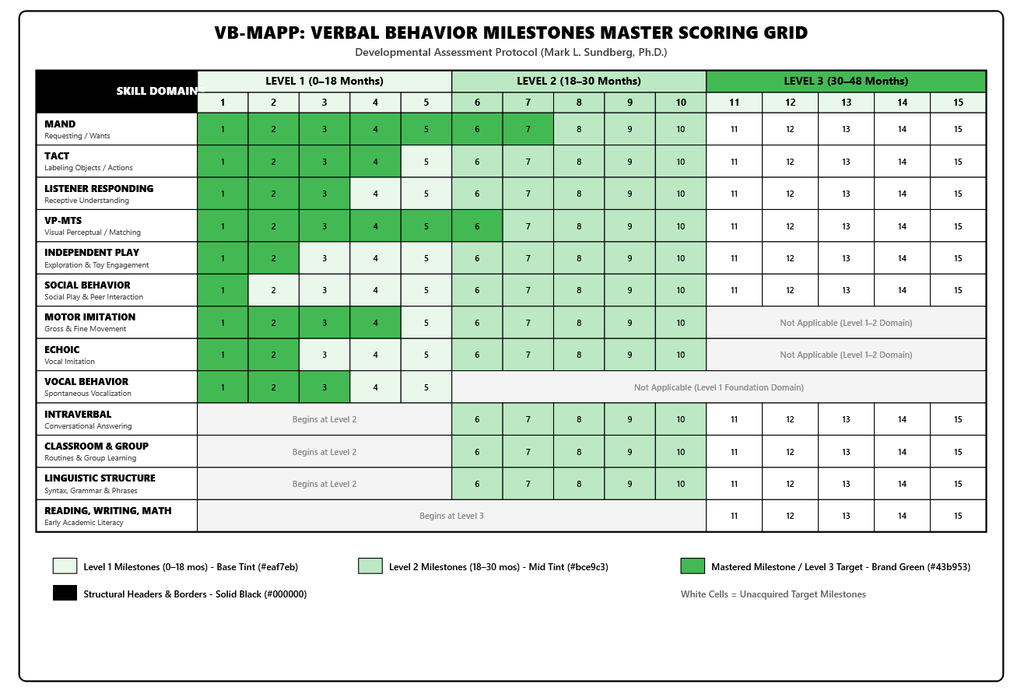
After the evaluation, your child’s raw scores are transferred onto the VB-MAPP Milestones Grid. Instead of presenting you with a dense, confusing diagnostic report filled with clinical acronyms, the grid provides an intuitive, color-coded visual overview.
The grid reflects three developmental stages:
- Level 1: 0 to 18 months developmental milestones
- Level 2: 18 to 30 months developmental milestones
- Level 3: 30 to 48 months developmental milestones
[ Colored Boxes ] ──> Demonstrated, independent milestone strengths
[ White Boxes ] ──> Targeted focus areas for the next learning phase
Colored blocks show mastered developmental skills; open blocks clearly identify where learning gaps exist.
This visual clarity makes it easy to collaborate. At Small Steps Big Dreams, we use these insights to build your child’s Individualized Education Plan (IEP), ensuring parents, clinical therapists, and school inclusion teams share the exact same priorities.
7. Frequently Asked Questions
Can I stay in the room during the assessment?
Yes. Your presence is tailored to what helps your child feel most secure. For younger toddlers, having a parent sitting nearby provides comfort. For older children, stepping slightly to the side once rapport is established often helps them interact more naturally with the assessor.
How long does a full VB-MAPP assessment take?
A thorough assessment typically spans between two and four hours. To avoid sensory fatigue and ensure authentic responses, we often divide the evaluation into two manageable, relaxed sessions across separate days.
How is the assessment adapted for multilingual children in Dubai?
Growing up in Dubai, many children hear a mix of English, Arabic, Hindi, French, or Tagalog at home and school. We use a Total Conceptual Vocabulary framework, crediting communication milestones across every language your child understands or uses, rather than evaluating them through an English-only lens.
How do Dubai mainstream schools use these results?
Dubai private schools operating under KHDA inclusive education frameworks rely on objective developmental baselines to structure classroom support. A VB-MAPP report provides school inclusion leads, class teachers, and Learning Support Assistants (LSAs) with specific, actionable goals, ensuring classroom accommodations are targeted and effective from day one.
Building a Clear Path Forward for Your Child
A VB-MAPP assessment replaces uncertainty with a structured, dignified plan for progress. By grounding the evaluation in playful, child-centered interaction, Small Steps Big Dreams helps families gain clarity on where their child shines and where targeted support will make the biggest difference.
Whether your priority is expanding communication at home or preparing for successful inclusion in a Dubai mainstream classroom, our Al Barsha clinical team is here to support you at every stage.
Take the Next Step
- For Families: Book an Initial Consultation at our Al Barsha Center to discuss your child’s developmental milestones with our clinical team.
- For School Inclusion Teams: Connect with our School Partnership Lead to learn how we integrate ABA therapy, LSA shadowing, and IEP alignment directly into Dubai classrooms.
Our Services
Recent Posts
- Home Developmental Activities for Children | Dubai Parent Guide Copy
- What Happens During a VB-MAPP Assessment? A Step-by-Step Guide for Parents
- Special Needs School in Nad Al Hamar: A Guide for Parents
- Speech Delay or Something Else? Understanding Communication Disorders in Young Kids
- Home Developmental Activities for Children | Dubai Parent Guide
- Parent Stories: Thriving in an Inclusive Classroom in Dubai
- (Guide) Occupational Therapy for Developmental Delay
- Speech Therapy for Bilingual Children: Unique Benefits and Approaches