
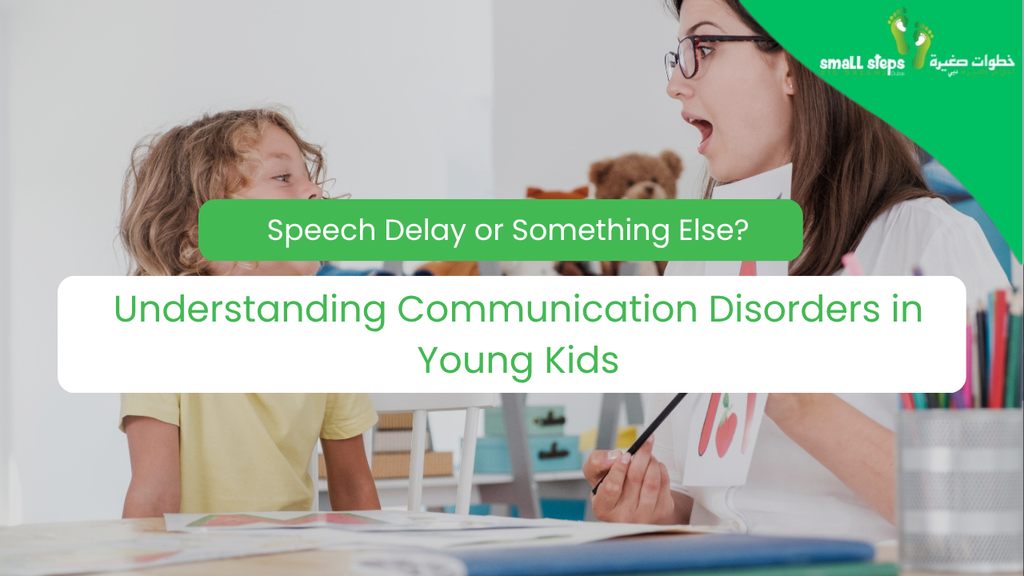
1. Introduction: Escaping the “Google Spiral”
It is 11:00 PM, your two-year-old is fast asleep, and you are staring at your phone screen searching “why isn’t my toddler talking yet?” Within three clicks, internet search results lead you straight to worst-case scenarios, leaving you overwhelmed by panic. You begin questioning every quiet moment, wondering if your child’s silence points toward a lifelong condition.
Before you let late-night searching determine your child’s developmental future, take a deep breath. A delay in talking can stem from several distinct pathways, most of which are highly responsive to early intervention. Jumping to dramatic conclusions without clinical data only adds unnecessary fear to your parenting journey.
Understanding the distinct map of communication differences is the fastest way to replace anxiety with actionable clarity. At Small Steps Big Dreams, we help Dubai families separate online myths from developmental facts. Let us break down how speech and language actually develop so you can take confident, informed next steps.
2. Speech vs. Language vs. Communication: What’s the Difference?
To understand what your child is experiencing, you must first understand that speech, language, and social communication are three completely separate developmental mechanisms. Parents often use these words interchangeably, but in pediatric clinical practice, they refer to very different functions.
Speech: The “Mouth Motor”
Speech refers strictly to the physical mechanics of producing articulate vocal sounds. It involves the complex motor coordination of the lips, tongue, vocal cords, jaw, and lungs to form audible words.
- The Analogy: Think of speech as the physical instrument or speaker hardware emitting sound.
- The Focus: Clarity, pronunciation, rhythm, and vocal sound production.
Language: The “Brain’s Code”
Language is the symbolic mental system used to understand and construct meaningful thoughts. It involves vocabulary knowledge, sentence structure, grammar, and the ability to organize ideas internally before sharing them.
- The Analogy: Think of language as the operating system or software program running behind the scenes.
- The Focus: Comprehension (Receptive Language) and expression (Expressive Language).
Social Communication (Pragmatics): The “Connection”
Pragmatics refers to how a child uses speech and language socially to connect, negotiate, and interact with others. It governs turn-taking in conversation, reading facial cues, maintaining eye contact, and adjusting tone based on the setting.
- The Analogy: Think of pragmatics as the social etiquette rules guiding how two devices communicate on a shared network.
- The Focus: Shared attention, eye contact, conversational turns, and playground peer play.
3. Unpacking the Major Types of Communication Disorders
When a child struggles to connect verbally, the underlying issue usually falls into one of four primary clinical categories. Pinpointing where your child struggles allows therapists to design a targeted support plan.
1. Simple Speech Delay
A child with a simple speech delay understands everything happening around them and possesses strong social motivation to connect. However, they struggle to physically pronounce specific age-appropriate speech sounds correctly, making their words sound slurred or immature.
- Key Indicator: They follow complex instructions easily and point eagerly to share joy, but unfamiliar adults struggle to understand their spoken words.
2. Expressive or Receptive Language Disorder
Language disorders occur when the brain struggles to process incoming information (Receptive) or build outgoing sentences (Expressive). A child with an expressive language disorder may pronounce single words clearly but cannot combine them into multi-word sentences. A child with a receptive language disorder may speak fluently but fails to comprehend basic classroom instructions.
- Key Indicator: They can repeat words like a parrot, but cannot answer simple questions like “Where is your shoe?” or organize thoughts into a phrase.
3. Childhood Apraxia of Speech (CAS)
Childhood Apraxia of Speech is a motor-planning challenge rather than a muscle weakness issue. The child’s brain knows exactly what it wants to say, but the neural signal traveling from the brain to the mouth gets scrambled along the way.
- Key Indicator: The child makes inconsistent sound errors (saying a word correctly once, then struggling to repeat it) and displays visible mouth groping while trying to position their lips.
4. Stuttering / Fluency Disorder
Fluency disorders involve interruptions in the smooth, natural flow of spoken language. A child may repeat initial sounds (e.g., “b-b-b-ball”), stretch out vowels, or experience physical “blocks” where sound briefly stops altogether.
- Key Indicator: Visible facial tension, rapid blinking, or physical struggle while trying to push a word out during conversation.
4. Quick-Reference Breakdown
Understanding how these conditions present at home helps you share accurate observations during an evaluation. The following table contrasts the core differences across these communication categories.
| Condition Name | Primary Challenge | Everyday Sign Seen at Home | Typical Focus in Therapy at Small Steps Big Dreams |
| Simple Speech Delay | Physical Sound Mechanics | Child says “tat” instead of “cat” consistently. | Articulation drills, tongue placement games, and mouth motor exercises. |
| Language Disorder | Structural Brain Processing | Child cannot follow “Get your shoes and wait at the door.” | Vocabulary expansion, sentence building, and receptive concept mapping. |
| Apraxia of Speech (CAS) | Neural Motor Planning | Child struggles visibly to position mouth for familiar words. | Multi-sensory syllable queuing, motor-pathway repetition, and rhythm mapping. |
| Stuttering / Fluency | Flow and Rhythm Control | Child gets stuck on initial sounds with visible facial tension. | Smooth speech pacing, tension release strategies, and confidence coaching. |
5. The Dubai Context: Multilingualism vs. True Disorder
Raising a child in Dubai means living in a vibrant, multilingual environment where English, Arabic, Hindi, Tagalog, or French blend daily. Many parents wonder if hearing multiple languages from family members, school teachers, and daytime caregivers is causing their toddler’s speech delay.
It is crucial to understand the gold-standard rule of bilingual development: multilingualism never causes a structural communication disorder. Exposing your child to multiple languages enriches their cognitive capacity and executive function without slowing down their fundamental brain development.
While a bilingual child may mix words across languages (code-switching) or take slightly longer to build a specific language’s vocabulary, their total conceptual knowledge tracks normally. If a true speech or language disorder exists, it will show up across all languages your child hears at home. If your child communicates effortlessly in your native language but struggles only in English, they are adapting to a new language, not experiencing a clinical disorder.
6. Erasing Parent Guilt and Stigma
When faced with a communication challenge, parents almost always shoulder unnecessary self-blame. You might ask yourself: “Did I allow too much screen time?”, “Did I work too many hours?”, or “Did moving to Dubai disrupt their development?”
A Vital Reminder for Parents
Communication disorders are neurodevelopmental differences and motor-planning challenges. They are nobody’s fault, and they are certainly not the result of loving parenting choices.
Holding onto guilt only consumes the emotional energy you need to advocate for your child. Children do not experience speech delays because you worked late or introduced a tablet during a long flight. Taking proactive steps to seek a professional screening is an act of deep parental love, not an admission of failure.
7. When to Seek a Specialist (Next Steps in Dubai)
If your child is missing age-appropriate benchmarks or experiencing daily frustration, taking structured action early changes everything. Navigating developmental support in Dubai requires understanding the distinct roles of medical practitioners and specialized therapy centers.
Understanding the Roles: Medical vs. Functional Evaluation
Formal medical or neurodevelopmental diagnoses (such as Autism, GDD, or clinical Apraxia) are made exclusively by licensed medical doctors, such as Developmental Pediatricians or Neurologists. These medical evaluations establish official diagnostic classifications required for insurance documentation or formal school placement files.
At Small Steps Big Dreams, we complement medical care by providing specialized, functional skill-building support. We conduct comprehensive functional skills assessments (such as the VB-MAPP and speech-language profiles) to pinpoint your child’s specific communication gaps. We then design play-based, individualized intervention plans to help your child master real-world communication at home and in the classroom.
The Path to School Readiness
Early communication support is the single most effective way to prepare your child for Foundation Stage (FS1/FS2) admissions assessments in Dubai private schools. Schools evaluate whether a child can follow group instructions, express choices clearly, and interact with peers during play-based screenings. Addressing speech or language delays early ensures your child enters their school intake assessment feeling calm, confident, and understood.
8. FAQ Section
Can waiting too long to address a speech delay make things worse?
Yes. When a child lacks the functional words to express their basic physical needs, that internal frustration frequently transforms into behavioral outbursts, biting, or social withdrawal. Early intervention prevents these negative behavioral loops and keeps your child’s learning trajectory on track.
Is a speech delay always a lifelong challenge?
No, absolutely not. Many young children who receive targeted, play-based communication support catch up completely with their peer group before entering primary school. Early speech support provides the exact scaffolding needed to bridge temporary learning gaps efficiently.
Can school inclusion teams help resolve communication issues?
Yes, school inclusion teams play a vital role alongside external specialists. When classroom teachers, Learning Support Assistants (LSAs), and therapists at Small Steps Big Dreams align their visual strategies, your child experiences a consistent environment that accelerates skill acquisition.
|
For families raising children in multilingual environments, understanding how bilingualism can influence communication development is important. Our guide to speech therapy for bilingual children explains the unique benefits and approaches that can support children developing communication skills across more than one language.
Conclusion: Turning Uncertainty into Progress
A speech delay or communication difference is not a permanent limitation on your child’s potential. It is simply a signpost telling you where your child needs structured, compassionate support right now. Moving away from online search results and stepping into a clear, data-driven evaluation removes the fear of the unknown.
At Small Steps Big Dreams, we are committed to helping your child find their unique voice. We work alongside your family and school community to transform early communication challenges into lasting developmental victories.
Our Services
Recent Posts
- Special Needs School in Nad Al Hamar: A Guide for Parents
- Speech Delay or Something Else? Understanding Communication Disorders in Young Kids
- Home Developmental Activities for Children | Dubai Parent Guide
- Parent Stories: Thriving in an Inclusive Classroom in Dubai
- (Guide) Occupational Therapy for Developmental Delay
- Speech Therapy for Bilingual Children: Unique Benefits and Approaches
- When to Start Speech Therapy for Children | Dubai Parent Guide
- Guide to School IEPs in Dubai | Understanding Individualised Education Plans


