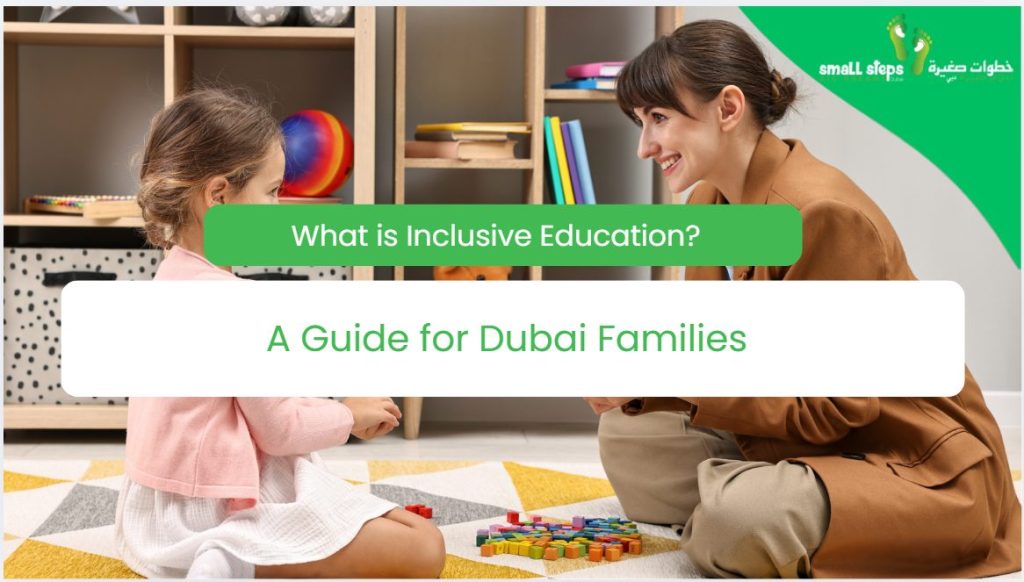
1. Introduction: The Inclusion Revolution in Dubai
It usually starts with an email. Perhaps it’s a feedback note from a nursery teacher or the results of an FS1 school assessment. For many Dubai parents, hearing the word “inclusion” for the first time triggers a wave of protective anxiety. You might worry about your child being “labeled” or wonder if they can keep up with the rigorous pace of a KHDA-rated curriculum.
But here is the reality: Dubai has become a global leader in inclusive education. As a leading Autism center in Dubai, we have seen firsthand how the city has moved past the era where children were “hidden away” to an era focused on belonging.
What this means for your child: Inclusion isn’t a “special” category; it is a right to be an active, valued member of a mainstream classroom. It means the school changes to fit your child, rather than forcing your child to fit a rigid mold.
2. Defining Inclusive Education (The Local Context)
In Dubai, “Inclusive Education” is legally protected. The Knowledge and Human Development Authority (KHDA) mandates that every private school must provide high-quality education to People of Determination.
It is important to distinguish between “Integration” (where a child sits in a classroom but does different work) and “Inclusion” (where the lesson is designed from the ground up to be accessible to everyone).
Practical Action: When touring schools, don’t just ask if they are inclusive. Ask for their “Inclusion Policy” and their “Inclusion Action Plan.” By law, these must be available to parents.
| Term | Simple Definition |
| People of Determination | The respectful UAE term for individuals with disabilities or special educational needs. |
| Mainstream | A standard classroom where students of all abilities learn and grow together. |
| Reasonable Adjustments | Specific changes a school makes—like extra time or sensory breaks—to remove barriers to learning. |
3. The “Win-Win”: Who Actually Benefits?
One common fear among parents is that an inclusive classroom might “slow down” the academic pace for other students. In reality, the opposite is true.
- Empathy as a Skill: Typical peers grow up viewing diversity as the norm. They develop the “soft skills”—patience, leadership, and emotional intelligence—that are vital for the modern workforce.
- Expert Teachers: To support a child with additional needs, a teacher must use advanced instructional strategies. These “multi-sensory” techniques actually help the entire class grasp complex concepts more easily.
- Diverse Thinking: Students learn that there are multiple ways to solve a problem, fostering a culture of innovation from a young age.
4. The Four Pillars of a Strong Dubai Program
A school isn’t inclusive just because it accepted your child’s application. A truly supportive environment is built on these four pillars:
A. The Inclusion Support Team
Every school must have an Inclusion Lead (sometimes called a SENDCO or Inclusion Coordinator). They are the “captain” of your child’s educational journey. They manage the Learning Support Assistants (LSAs)—often referred to as Shadow Teachers.
A Note on Logistics: In many Dubai schools, while the school provides the framework, the financial cost of a 1-on-1 LSA/Shadow Teacher often falls to the parents via an Individual Service Agreement.
B. The IEP (Individualized Education Plan)
Think of the IEP as a GPS for your child’s school year. It identifies exactly where they are now, where they need to go, and which specific “roads” (strategies) they will take to get there. It is a living document, not a one-time report.
C. Environmental Adaptations
A school should offer more than just a desk. Look for Visual Schedules (pictures showing the day’s routine) and Sensory Zones (quiet corners where a child can “reset” if the classroom noise becomes overwhelming).
D. The Parent Partnership
In Dubai, you are a “Partner in Progress.” The school should meet with you at least once a term to review data and adjust the IEP. You are an expert on your child, and your input is vital.
5. Navigating Dubai’s Policy Framework
The KHDA “Dubai Inclusive Education Policy Framework” is your strongest tool. It states that schools cannot refuse a child based solely on their disability.
What to look for on a school tour:
- The Vibe: Do you see People of Determination moving freely between classes, or are they isolated in a separate “unit”?
- The Assessment: Schools can conduct “assessments for placement,” but these should be used to determine the level of support needed, not to decide whether to “reject” the child.
6. Addressing Parent “Heart” Concerns
- “Will my child be bullied?” Dubai schools have strict, KHDA-mandated anti-bullying policies. Because inclusion starts in FS1, children learn from age three that everyone learns differently, which naturally reduces stigma.
- “Will the pace be too slow?” Your child’s success is measured against their personalized IEP goals, not just the average of the class. This ensures they are always challenged at their own level.
- “How will they make friends?” Strong inclusion teams use “Buddy Systems,” pairing social peers with students who need a little extra help navigating the playground or group projects.
7. FAQ Section
Is inclusion right for every child?
The goal is the “Least Restrictive Environment.” This means your child should be in the most accessible setting possible, which is appropriate to their needs, where they can still achieve their goals.
How do I apply for extra support?
Once you have a clinical diagnosis (e.g., Autism, ADHD, or Global Developmental Delay), share the report with the school’s Inclusion Lead. They will then conduct an internal observation to trigger the support process.
What is the difference between an IEP and a lesson plan?
A lesson plan is for the whole class. An IEP is a legal document specifically for your child that ensures they receive the modifications they need to succeed.
Conclusion: The Journey to Belonging
Inclusion is not a destination; it is a collaborative journey. In Dubai, we are fortunate to have laws that ensure no child is left behind.
At Small Steps Big Dreams, we reduce the gap between clinical therapy and the classroom. We work directly with Inclusion Leads across Dubai schools to ensure the progress your child makes in our center translates into success at their school.
Practical Action: If the school search or the IEP process feels overwhelming, you don’t have to navigate it alone.
Download our Guide to Navigating KHDA School Assessments
Our Services
Recent Posts
- Speech Delay or Something Else? Understanding Communication Disorders in Young Kids
- Home Developmental Activities for Children | Dubai Parent Guide
- Parent Stories: Thriving in an Inclusive Classroom in Dubai
- (Guide) Occupational Therapy for Developmental Delay
- Speech Therapy for Bilingual Children: Unique Benefits and Approaches
- When to Start Speech Therapy for Children | Dubai Parent Guide
- Guide to School IEPs in Dubai | Understanding Individualised Education Plans
- Global Developmental Delay vs Autism | Dubai Parent Guide