
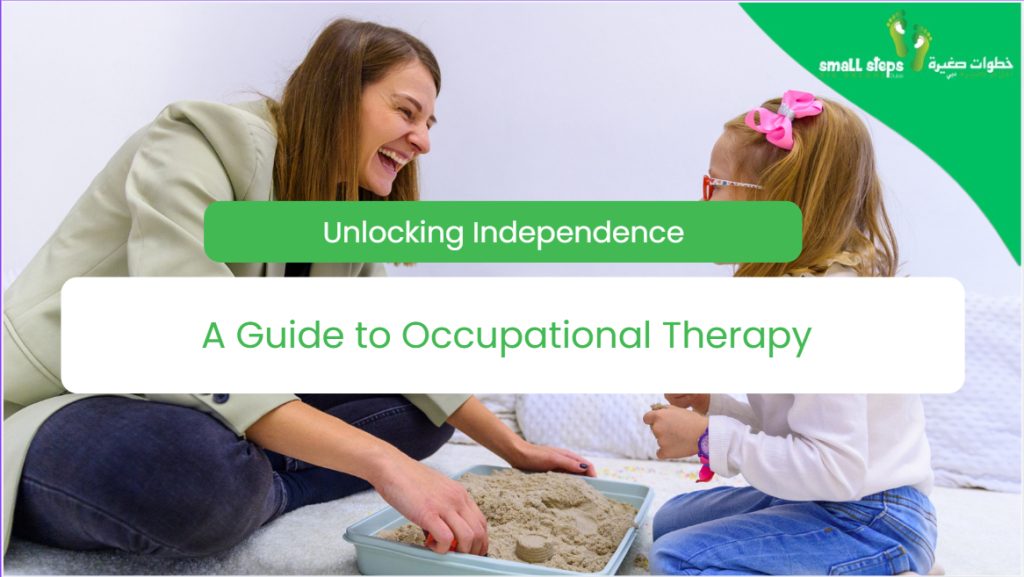
When you hear the word “occupation,” you likely think of a career or a daily job. For an adult, that is true. But for a child, their “occupations” are much more fundamental to their growth and happiness.
A child’s job is to play, to learn in a classroom, to dress themselves, and to make friends at a birthday party. When a child struggles with these everyday tasks, it can impact their confidence and their ability to belong. This is where Occupational Therapy (OT) becomes essential.
At Small Steps Big Dreams, we view OT as more than just a clinical service. It is a pathway to freedom. For People of Determination in Dubai, OT is the “secret sauce” that transforms “I can’t” into “I can.”
1. More Than Just “Motor Skills”
Many parents initially think Occupational Therapy is only about physical movement. While physical strength is part of it, OT goes much deeper. It focuses on the “functional” side of life how your child uses their body and mind to navigate their world.
Imagine your child trying to join a game of tag at a park in Al Barsha. They need the balance to run, the social awareness to follow the rules, and the sensory focus to handle the noise of other children shouting. OT helps your child master all of these layers at once.
The goal of OT isn’t just to “fix” a specific delay. It is about unlocking your child’s ability to participate in daily life with joy. Whether it is successfully using a fork at a family brunch or staying calm in a busy Dubai mall, OT provides the tools for success.
2. What Exactly is Pediatric Occupational Therapy?
We often describe Occupational Therapy as the “Bridge to Independence.” On one side is where your child is now, and on the other is a life where they can do things for themselves. OT provides the stones to cross that gap.
To understand how this bridge is built, we look at three primary domains:
Fine Motor Skills
These are the small movements made with the hands and fingers. Think of these as “precision” skills.
- Real-World Example: Using a zipper on a school jacket or picking up a small LEGO piece.
- Why it matters: Without these, schoolwork like writing or drawing becomes frustrating and exhausting.
Gross Motor Skills
These involve the large muscles of the body that help with balance and coordination.
- Real-World Example: Knowing how to climb the ladder at a play zone or staying upright on a moving school bus.
- Why it matters: These skills allow your child to stay active and keep up with their peers during physical activities.
Sensory Processing
This is how the brain organizes information from the five senses, plus two “hidden” senses: balance and body awareness.
- Real-World Example: Handling the bright lights and loud music of a Dubai cinema without feeling overwhelmed.
- Why it matters: If a child’s brain cannot filter out background noise or light, they cannot focus on a teacher’s instructions.
3. The Benefits: A Holistic View
Occupational Therapy looks at the whole child, not just a single symptom. By working on these areas, your child develops a sense of “mastery” over their own life.
| Area of Development | The OT Impact | What this looks like for your child |
| Fine Motor | Precision and Strength | Your child can hold a pencil correctly and write their name without pain. |
| Sensory Integration | Emotional Regulation | Your child can stay calm in a crowded Global Village environment. |
| Social Skills | Interaction and Play | Your child learns how to take turns and understand personal space. |
| ADLs (Activities of Daily Living) | Self-Care Independence | Your child can brush their teeth and get dressed for school on their own. |
4. When Should You Consider OT? (The Checklist)
Every child develops at their own pace, but there are certain “red flags” that suggest a child might need extra support. In Dubai’s high-achieving school culture, visiting a specialized autism center in Dubai for early intervention is the best gift you can give.
Ask yourself if your child struggles with these tasks:
- The “Clumsy” Factor: Does your child trip often or struggle to navigate obstacles in a playground?
- School Struggles: Does your child have messy handwriting or find it hard to sit still in a chair for 10 minutes?
- Sensory Sensitivity: Does your child cover their ears when they hear a hand dryer in a mall restroom?
- Self-Care Hurdles: Is your child over the age of five but still needs help using cutlery or buttoning their shirt?
- Limited Play: Does your child play with toys in unusual ways, like only spinning the wheels of a car instead of “driving” it?
If you checked more than two of these boxes, a consultation is a smart next step. Addressing these challenges early prevents them from turning into “avoidance behaviors” where a child simply stops trying.
5. The “Team Child” Process
At Small Steps Big Dreams, we don’t believe in a “revolving door” approach to therapy. We build a life plan for your child. The process is a journey that we take together.
The Assessment
The journey starts with a deep dive. Our therapists observe your child’s movements, sensory responses, and social interactions. We don’t just look at what they can’t do; we find their strengths to build on.
The Roadmap (Goal Setting)
Once we have the data, we create the roadmap. These aren’t just clinical goals; they are life goals. We might set a goal for your child to be able to “dress themselves for school independently in 3 months.”
Play-Based Sessions
This is the part children love. In our center, therapy looks like play. Your child might navigate an obstacle course to improve Proprioception (that’s a fancy word for “knowing where your body is in space”). To them, it’s a game; to us, it’s brain training.
Progress Tracking
We constantly measure and pivot. If a specific technique isn’t clicking, we change it. We celebrate the “small wins”, like the first time your child ties their own shoelaces because those small steps lead to big dreams.
6. The Dubai Home & School Connection
Dubai is a unique place to raise a child. Between the heat keeping us indoors and the multicultural nature of our schools, children face specific challenges.
The Inclusive Classroom
The KHDA (Dubai’s education regulator) has a strong vision for inclusive education. A child with an Occupational Therapist in their corner is much better equipped to thrive in a mainstream school. We work to ensure your child has the stamina and focus to succeed in a classroom alongside their peers.
What this means for your child:
Small Steps Big Dreams therapists often conduct school observations. We look at how your child sits at their desk and how they interact at recess. We then give the teacher practical tips like using a slanted board for writing to make the school day easier for your child.
The Home Environment
We also look at life at home. Many families in Dubai have nannies or live in high-rise apartments. We provide “Home Programs” so that the progress made in our clinic continues in your living room. We might suggest specific sensory activities or ways to rearrange a play area to encourage more movement.
Conclusion: Investing in the Future
Occupational Therapy isn’t a “forever” commitment for every child, but the skills learned are for a lifetime. By helping your child master the “occupations” of childhood, you are setting them up for a successful, independent adulthood.
Whether your child is a Person of Determination with a specific diagnosis or simply a child who needs a little help with coordination, OT provides the foundation.
Small Steps Big Dreams is here to be your partner in this journey. We combine world-class expertise with a warm, family-focused approach.
Take the first step today.
Book an Occupational Therapy Assessment . You can also explore our full Developmental Pathway on our website to see how OT integrates with Speech and ABA therapy to support your child’s holistic growth. Your child’s independence starts with a single step.
Our Services
Recent Posts
- Speech Delay or Something Else? Understanding Communication Disorders in Young Kids
- Home Developmental Activities for Children | Dubai Parent Guide
- Parent Stories: Thriving in an Inclusive Classroom in Dubai
- (Guide) Occupational Therapy for Developmental Delay
- Speech Therapy for Bilingual Children: Unique Benefits and Approaches
- When to Start Speech Therapy for Children | Dubai Parent Guide
- Guide to School IEPs in Dubai | Understanding Individualised Education Plans
- Global Developmental Delay vs Autism | Dubai Parent Guide


