
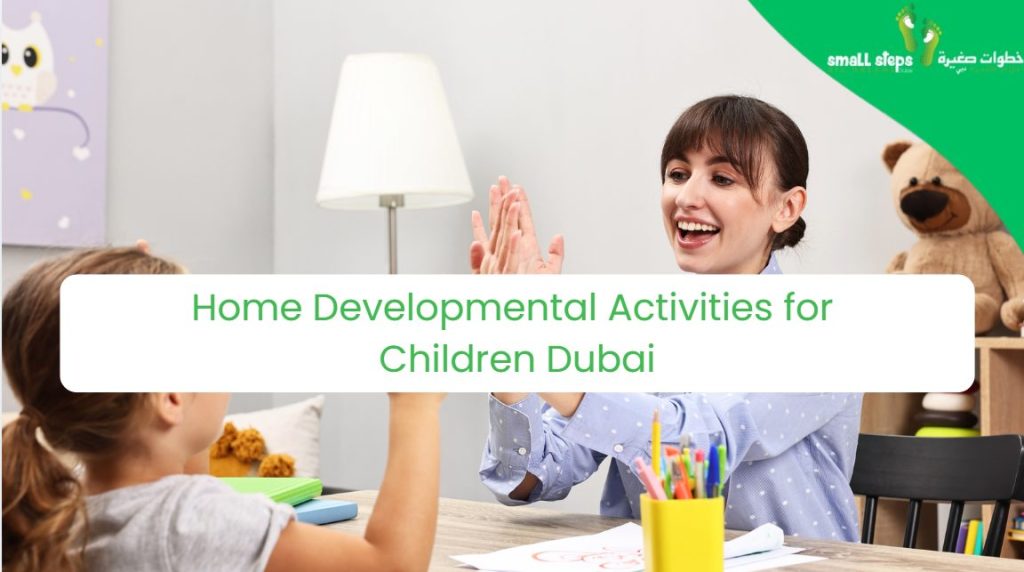
1. Introduction: The “Waiting Room” Anxiety
You’ve made the call. You’ve acknowledged the concerns, and you’ve reached out for help. But now, you find yourself on a waiting list. In a busy city like Dubai, where demand for high quality support is high, the “wait” can feel like an eternity. You might feel like your child is losing valuable time every day they aren’t in a clinic.
At Small Steps Big Dreams, a premier Autism center in Dubai, we want to change your perspective on this waiting period. While specialized therapy happens in a clinic, real, lasting progress happens at home. Your child’s most important teacher isn’t a therapist, it’s you.
Our mission is to help you turn your daily Dubai routine into a series of “developmental wins.” You don’t need expensive equipment or a clinical degree. You only need 10 minutes, a few household items, and a shift in how you view your everyday interactions.
2. Speech & Language: Narrating the World
Communication is more than just saying words; it’s about the desire to connect. In the UAE, many children are “screen-rich but language-poor.” We can fix this by increasing the “word-count” in your home through simple, low-prep habits.
The “Sportscaster” Technique
Imagine you are a sports commentator describing a match. Instead of a football game, you are narrating your chores. This exposes your child to the “sound” of language without the pressure of having to respond.
- How to do it: While making a snack, say, “I am peeling the orange. It is cold. Now, I am putting it on the blue plate.”
- Why it works: It builds your child’s “receptive language” their ability to understand words before they can speak them.
The “Power of Choice”
We often anticipate our children’s needs so well that they never have to speak. If you always give them their favorite juice without them asking, they lose a chance to communicate.
- How to do it: Hold up two items. Ask, “Do you want the apple or the biscuit?” Wait for 5 seconds before giving it to them.
- What to look for: Even a point, a grunt, or eye contact toward the item is a win. You are teaching them that their actions have power.
Involving the Nanny
If your child spends a large part of the day with a nanny while you are at work in DIFC or Media City, they are a vital part of the team.
- Action Step: Encourage your nanny to use the “Sportscaster” technique during bath time or diaper changes.
- Dubai Tip: If your household is multilingual, don’t worry about “confusing” the child. Use your strongest home language, and encourage your nanny to speak clearly in theirs. Consistency in interaction is more important than the specific language used.
3. Fine & Gross Motor: The “Household Gym”
Physical development is divided into two categories. Fine Motor skills involve the small muscles in the hands used for writing or using a fork. Gross Motor skills involve large muscles used for running, jumping, and balance.
Fine Motor: The Kitchen Tongs Challenge
You don’t need specialized “OT toys” to build hand strength. Your kitchen drawer is full of therapy tools.
- The Activity: Give your child a pair of kitchen tongs and two bowls. Have them move dry pasta or large pom-poms from one bowl to the other.
- What this means for your child: This mimics the “pincer grasp” they will eventually need to hold a pencil correctly at school.
Gross Motor: Animal Walks
Dubai apartments can feel small, but you can turn a hallway into a gym.
- The Activity: Instead of walking to the bathroom to brush teeth, try “Animal Walks.”
- Options: Bear crawl (hands and feet on the floor), Frog jumps (squatting and leaping), or Flamingo stands (balancing on one leg while counting to five).
- High-Rise Living Note: These activities provide “heavy work” for the muscles, which helps children feel more grounded and calm when they are stuck indoors during the summer heat.
Balcony “Water Painting”
If you have a balcony or a small outdoor space, water is a mess-free way to practice motor control.
- The Activity: Give your child a bucket of water and a large paintbrush. Let them “paint” the walls or the floor with water.
- Why it works: Reaching high and low builds shoulder stability, which is the foundation for all fine motor tasks.
4. Social-Emotional: “People Games”
Before a child can learn to follow school rules, they must master Joint Attention. This is a fancy term for when two people share an interest in the same thing at the same time like both looking at a plane flying over Safa Park.
“Ready, Set, Go”
This is the simplest way to build anticipation and social connection.
- The Activity: Use a ball or a toy car. Hold it at the top of a ramp or in your hand. Say, “Ready… Set…” and then pause.
- The Goal: Wait for your child to look at you or make a sound before you say “GO!” and release the toy.
- The Win: You are teaching your child that looking at you makes the fun thing happen.
The Mirror Game
Emotional recognition is a core social skill.
- The Activity: Sit in front of a mirror with your child. Make a “Happy” face and say the word. Then make a “Sad” face or a “Surprised” face.
- Next Step: See if they can imitate your face. This helps children connect a physical feeling (like a smile) with a social concept (like happiness).
5. Tracking Progress: The Milestone Log
When you are waiting for professional support, it’s easy to feel like nothing is changing. However, progress often happens in tiny, quiet moments. Small Steps Big Dreams recommends keeping a “Small Wins Diary.”
Your Weekly Milestone Template
Instead of focusing on what your child can’t do, record what they did do this week.
| Date | The “Small Win” | Category |
| Oct 12 | Pointed at the milk carton in the fridge. | Speech/Communication |
| Oct 14 | Used tongs to move 5 pieces of pasta. | Fine Motor |
| Oct 15 | Looked at me for 3 seconds during “Ready, Set, Go.” | Joint Attention |
Why this matters: When you eventually meet your therapist, this log provides better data than any clinical test. It shows the therapist exactly how your child learns in their real environment.
6. When the “Wait” Isn’t an Option: Red Flags
While home activities are incredibly powerful, they are a supplement, not a replacement, for professional intervention for People of Determination. There are certain “Red Flags” that mean you should contact your pediatrician or a specialist immediately:
- Regression: If your child suddenly loses words or social skills they once had.
- Total Lack of Social Smile: If your child does not smile back at you or seek your attention by 12 months.
- Safety Concerns: If your child is frequently hurting themselves or others, or if they have zero awareness of danger (e.g., running toward a busy Dubai road).
- Hearing Concerns: If they consistently do not respond to their name or loud noises.
Note: Home programs are meant to empower you, but a formal pediatric assessment in Dubai is necessary to create a clinical roadmap for long-term success.
7. FAQ Section
Will home activities really make a difference?
Yes. Consistency is the number one driver of developmental progress. Ten minutes of focused interaction every day is often more effective than a single one-hour therapy session once a week.
What if my child refuses to participate?
Never force an activity. We use a “Follow the Child’s Lead” approach. If you want to do “Animal Walks” but they want to play with blocks, bring the “Animal Walk” to the blocks. Have the bear crawl over to the “construction site.”
Should we push for more therapy hours or focus on home work?In therapy, quality always beats quantity. It is better to have two high-quality sessions a week where the parent learns how to carry over the skills at home than to have five sessions a week where the parent is not involved.
Conclusion: You Are the Solution
Waiting for a therapy slot is a challenge, but it is also an opportunity. It is a time to strengthen your bond with your child and to realize that you are the most influential person in their world.
Every time you narrate a walk through Barsha Pond Park or play “Ready, Set, Go” with a toy car, you are building the neural pathways your child needs to succeed. You are moving from a state of “Waiting” to a state of “Action.”
At Small Steps Big Dreams, we are here to support you through the wait and beyond. Our center is dedicated to providing family-focused, individualized support that starts the moment you walk through our doors.
Don’t just wait, take the first step.
Book a low-pressure parent coaching session. You can also explore our complete Developmental Pathway on our website to see how we bridge the gap between home play and clinical progress. Your child’s dreams are worth the effort, and we are with you every step of the way.es together.toddler grow!
Our Services
Recent Posts
- Speech Delay or Something Else? Understanding Communication Disorders in Young Kids
- Home Developmental Activities for Children | Dubai Parent Guide
- Parent Stories: Thriving in an Inclusive Classroom in Dubai
- (Guide) Occupational Therapy for Developmental Delay
- Speech Therapy for Bilingual Children: Unique Benefits and Approaches
- When to Start Speech Therapy for Children | Dubai Parent Guide
- Guide to School IEPs in Dubai | Understanding Individualised Education Plans
- Global Developmental Delay vs Autism | Dubai Parent Guide


