Understanding Individualised Education Plans (IEPs) in Dubai: A Parent Guide to School Support, Inclusion, and Educational Planning
Understanding Individualised Education Plans (IEPs)
Many parents first hear the term Individualised Education Plan (IEP) during a school meeting, after receiving an assessment report, or while discussing concerns about their child’s learning or development. For some families, the terminology can feel unfamiliar and overwhelming at first.
It is important to remember that an IEP is not a record of what a child cannot do. It is a planning tool designed to help schools understand how to support a student’s learning, participation, and progress within the educational environment.
Every child learns differently. Some children may require additional support to access the curriculum, communicate effectively, participate in classroom routines, develop independence, or demonstrate their knowledge. An IEP helps bring together the strategies, accommodations, goals, and resources that support those needs.
In Dubai’s increasingly inclusive education system, IEPs play an important role in ensuring that children receive meaningful access to learning opportunities while remaining active participants in school life.
Whether your child has recently received a diagnosis, is receiving learning support, or has been identified by their school as needing additional assistance, understanding how IEPs work can help you feel more confident and informed throughout the process.
What is an IEP?
An Individualised Education Plan (IEP) is a structured educational planning document used by schools to identify goals, support strategies, accommodations, and monitoring processes for a student who may require additional support to access learning.
The purpose of an IEP is to create a shared understanding among parents, teachers, inclusion staff, and other professionals about how a child’s educational needs will be supported within the school environment.
A high-quality IEP should clearly describe:
- The student’s current strengths and areas of need
- Educational goals and targets
- Classroom accommodations and support strategies
- Any curriculum modifications, where appropriate
- Staff responsibilities
- Progress monitoring procedures
- Review timelines
Rather than focusing solely on challenges, an effective IEP recognises a child’s strengths and uses them as a foundation for learning and development.
Who Might Benefit From an IEP?
An IEP may be appropriate for students who require additional educational support due to:
- Autism Spectrum Disorder (ASD)
- Attention-Deficit/Hyperactivity Disorder (ADHD)
- Global Developmental Delay (GDD)
- Speech and language difficulties
- Specific learning difficulties such as dyslexia
- Intellectual disabilities
- Physical disabilities
- Sensory differences
- Other developmental, learning, or medical needs that affect access to education
Not every child receiving additional support requires an IEP, and the level of support needed varies significantly from one student to another.
The purpose of the plan is not to create a separate educational pathway but to help each student participate meaningfully in school while working towards realistic and achievable goals.
Understanding Accommodations and Modifications
One of the most common areas of confusion during IEP discussions is the difference between accommodations and modifications.
Although these terms are sometimes used interchangeably, they describe two different approaches to educational support.
Accommodations: How a Child Accesses Learning
Accommodations are adjustments that help a student access learning without changing the curriculum expectations.
The learning objectives remain the same as those of their peers, but the way information is presented or how the student demonstrates learning may be adjusted.
Examples of accommodations may include:
- Extra time during assessments
- Visual schedules and visual supports
- Preferential seating
- Reduced distractions within the classroom
- Access to assistive technology
- Movement or sensory breaks
- Alternative methods of demonstrating understanding
- Simplified instructions
Accommodations help remove barriers to learning while maintaining access to the same curriculum.
Modifications: What a Child is Expected to Learn
Modifications involve changes to the curriculum itself.
This may include adjusting learning expectations, reducing the complexity of content, or focusing on different learning objectives than those being taught to the wider class.
Examples of modifications may include:
- Adjusted literacy targets
- Alternative mathematics objectives
- Simplified academic content
- Functional life-skills goals incorporated into the school day
Not every student with an IEP requires curriculum modifications. Many students benefit from accommodations alone and continue working towards the same curriculum outcomes as their peers.
The most appropriate approach depends on the student’s individual profile, strengths, and educational needs.
The IEP Process in Dubai Private Schools
Although procedures vary slightly between schools, most Dubai private schools follow a structured process when developing and implementing Individualised Education Plans.
Successful IEP development relies on collaboration between families, educators, inclusion teams, and external professionals where appropriate.
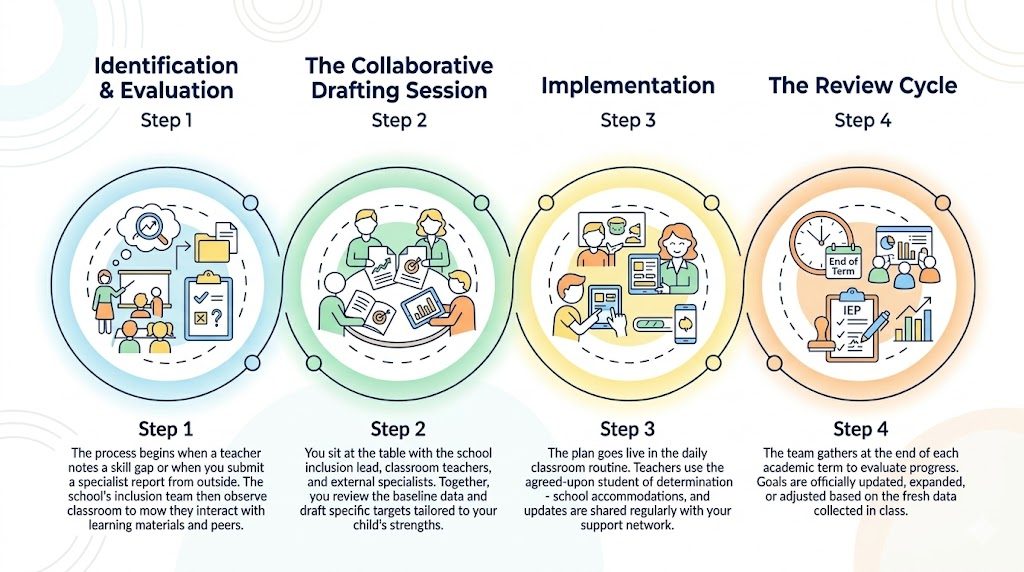
Stage 1: Identification and Information Gathering
The process often begins when concerns are raised regarding a student’s learning, communication, participation, behaviour, social interaction, or academic progress.
These concerns may come from:
- Parents
- Teachers
- Inclusion teams
- Healthcare professionals
- External therapists
- Assessment reports
The school gathers information through observations, educational assessments, teacher feedback, and existing professional reports.
The goal is to develop a clear understanding of the student’s current level of functioning and educational needs.
Stage 2: Collaborative Planning
Once information has been collected, the school arranges a meeting involving relevant stakeholders.
This may include:
- Parents
- Classroom teachers
- Inclusion teachers
- School leaders
- Learning support staff
- External professionals, where appropriate
During this stage, the team reviews assessment findings, discusses priorities, and develops educational goals that are relevant, meaningful, and achievable.
Parents play an important role in this process by sharing information about their child’s strengths, interests, challenges, and experiences outside school.
Stage 3: Implementation
Following agreement on the plan, the IEP is implemented within the school environment.
Teachers and support staff begin using the agreed strategies, accommodations, resources, and teaching approaches outlined in the document.
Implementation may occur across:
- Classroom learning
- Small-group support
- Specialist intervention sessions
- Playground and social environments
- School routines and transitions
Consistency between home, school, and therapy settings can help support progress.
Stage 4: Monitoring and Review
An IEP is intended to be a living document rather than a static report.
Schools monitor progress throughout the year and review goals at agreed intervals.
Review meetings allow the team to:
- Evaluate progress
- Celebrate achievements
- Adjust support strategies
- Update goals
- Address emerging needs
If concerns arise before the scheduled review date, parents can request additional discussions with the school’s inclusion team.
What Should Be Included in a High-Quality IEP?
Not all IEPs are equally effective.
A strong IEP should be specific, measurable, practical, and meaningful. It should provide clear guidance for the adults supporting the child while ensuring that progress can be monitored objectively.
Present Levels of Performance
This section describes the student’s current abilities and educational profile.
It should include objective information about:
- Academic skills
- Communication abilities
- Social development
- Independence skills
- Behavioural or emotional needs, where relevant
- Areas of strength
Clear baseline information helps everyone understand where the student is starting from and provides a reference point for measuring progress.
Measurable SMART Goals
Goals should be:
- Specific
- Measurable
- Achievable
- Relevant
- Time-bound
Well-written goals help teachers, parents, and support staff understand exactly what success looks like.
You can also read: What is Inclusive Education? A Guide for Dubai Families
Support Strategies and Accommodations
The IEP should clearly outline:
- Classroom accommodations
- Learning support strategies
- Resources required
- Assistive technology, where relevant
- Staff responsibilities
- Support frequency
The document should provide enough detail that support remains consistent across different staff members and educational settings.
Goal Examples: General vs. Measurable
| General Goal | Measurable Goal |
|---|---|
| The student will improve classroom participation. | During whole-class activities, the student will cooperate with group instruction in 4 out of 5 opportunities across four consecutive weeks. |
| The student will improve reading skills. | The student will accurately read 20 high-frequency sight words with 80% accuracy by the end of Term 1. |
The more clearly goals are defined, the easier it becomes to monitor progress and make informed decisions about future support.
Working in Partnership With Your School
Parents are an essential part of the IEP process.
Schools contribute educational expertise, while families provide valuable insight into their child’s personality, strengths, interests, communication style, and daily experiences.
The most effective IEPs are developed through open communication and genuine collaboration.
Parents can support the process by:
- Attending review meetings
- Asking questions when information is unclear
- Sharing relevant reports and updates
- Discussing concerns early
- Celebrating progress alongside the school team
A collaborative approach helps ensure that educational goals remain meaningful and relevant to the child’s everyday life.
How Small Steps Big Dreams Can Support Families
Where appropriate, Small Steps Big Dreams can work collaboratively with families and schools to help align therapy goals, educational priorities, and support strategies across settings.
Our team may provide:
- Developmental assessments
- Educational consultation
- School collaboration
- Progress monitoring recommendations
- Support planning guidance
The goal is to help create consistency between home, school, and therapy environments while supporting each child’s individual learning journey.
Frequently Asked Questions
How often are IEPs reviewed in Dubai schools?
Most schools formally review IEPs at least once each academic term. Review schedules may vary between schools, and additional meetings can often be arranged if concerns arise.
What happens if my child’s classroom teacher changes?
A well-developed IEP provides continuity across staff changes. New teachers should review the document and continue implementing the agreed accommodations, strategies, and goals.
What if the current goals are not working?
If you feel your child is not making progress or the goals no longer reflect their needs, you can request an additional review meeting with the school’s inclusion team.
Regular communication helps ensure that support remains appropriate and responsive.
Does having an IEP affect my child’s ability to attend a mainstream school?
Not necessarily.
Many students with IEPs successfully attend mainstream schools. In fact, IEPs are often designed specifically to support meaningful participation and inclusion within mainstream educational environments.
Can external professionals contribute to an IEP?
Many schools welcome input from external professionals, including psychologists, speech and language therapists, occupational therapists, developmental specialists, and other healthcare providers.
Collaboration between professionals can help create a more comprehensive understanding of the student’s needs.
Conclusion: A Shared Plan for Learning and Inclusion
An Individualised Education Plan is more than a document. It is a practical framework that helps schools, families, and support professionals work together towards shared educational goals.
A strong IEP provides clarity, consistency, and structure while recognising each student’s unique strengths, learning profile, and support needs.
When families and schools collaborate effectively, children are more likely to receive the support they need to participate confidently in learning, build independence, and achieve meaningful progress.
At Small Steps Big Dreams, we work alongside families across Dubai to support developmental growth, educational planning, and successful school participation.
If you would like guidance on understanding your child’s educational needs or reviewing an existing support plan, our team is here to help.
Download our IEP Review Guide for Parents OR book an educational consultation to discuss your child’s support plan. You can also explore our School Inclusion Guide to learn more about inclusive education and support pathways in Dubai.
Our Services
Recent Posts
- Speech Delay or Something Else? Understanding Communication Disorders in Young Kids
- Home Developmental Activities for Children | Dubai Parent Guide
- Parent Stories: Thriving in an Inclusive Classroom in Dubai
- (Guide) Occupational Therapy for Developmental Delay
- Speech Therapy for Bilingual Children: Unique Benefits and Approaches
- When to Start Speech Therapy for Children | Dubai Parent Guide
- Guide to School IEPs in Dubai | Understanding Individualised Education Plans
- Global Developmental Delay vs Autism | Dubai Parent Guide